
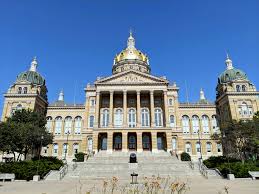
This Week in the Iowa Legislature
This week brought movement on several hot issues at the statehouse, including the Senate’s approach to the carbon pipeline and eminent domain debate, House Republicans’ rollout of “tough on crime” legislation, and action on property tax reform. While these issues dominated our attention, the legislative schedule was somewhat compressed. On Tuesday, the Legislature convened for a half day as many lawmakers attended President Donald Trump’s speech in Clive, marking the kickoff of the 2026 election cycle for Republicans. Lawmakers returned on Wednesday and Thursday to a packed slate of subcommittee and committee meetings to close out the week.
Our thoughts are with Senator Catelin Drey, who announced Monday that she has been diagnosed with stage one uterine cancer and will undergo a hysterectomy as part of her treatment. Senator Drey shared her diagnosis publicly, emphasizing the importance of access to quality care and early detection, and pledged transparency throughout her recovery. We wish her a quick and full recovery and look forward to her return to the Capitol when she is able.
The week also included organizational news on the Democratic side, with the launch of the Iowa Legislative Black and Brown Democratic Caucus. Members stated the caucus will focus on solutions, accountability, and equity, with an emphasis on issues that disproportionately impact Black and Brown Iowans.
Carbon Pipeline and Eminent Domain Update
The most persistent and contentious issue of the session—carbon dioxide pipelines and eminent domain—saw significant action again this week, with both committee and subcommittee movement in the Senate further underscoring the divide between the House and Senate approaches.
Early in the week, the Senate Commerce Committee amended and advanced HF 2104, which addresses eminent domain authority for carbon pipelines. Rather than adopting the House-passed ban on eminent domain, the committee approved a strike-and-replace amendment (S 5001) that substitutes the language of SF 2067, shifting the policy approach to require pipeline companies to pursue alternative routes and rely on voluntary easements instead of condemnation. The bill was advanced out of committee on a 13–5 party-line vote, with the understanding that it will be substantially rewritten as it continues through the process. Senator Petersen objected to taking up HF 2104 at that time, citing the lack of prior public input on the substituted Senate language.
On Thursday, the Senate Commerce subcommittee on SF 2067 met and advanced the bill on a 2–1 vote, completing the procedural steps needed since the language has already been incorporated into HF 2104 and approved by the full committee. Senate Majority Leader Mike Klimesh said the proposal is intended to give power to both landowners and pipeline companies by allowing voluntary easements while enabling landowners who object to prevent pipelines from crossing their property.
The Senate’s approach continues to draw sharp criticism from Democrats and landowners who support the House ban, arguing it fails to adequately protect farmland from the threat of eminent domain. Senator Petersen opposed the bill both as a committee amendment and in subcommittee, stating she does not view the proposal as a true compromise. Supporters, including some labor, renewable fuels, and agricultural interests, argue the approach preserves jobs and allows projects to proceed without forced easements, though representatives from Summit Carbon Solutions warned the new requirements could significantly increase costs.
At this point, there are no clear signs of an agreement between House and Senate Republicans. HF 2104 which now matches the language of the Senate’s bill is now eligible for floor debate as early as next week, setting the stage for continued conflict on one of the session’s most closely watched issues.
Property Tax Reform Proposals
House Republicans made the first move on property tax legislation as they passed their proposal through the Ways and Means subcommittee with a vote of 3-2. The House plan includes a 2 percent annual revenue growth cap for cities and counties, a residential property tax exemption, and policy changes aimed at providing greater predictability for taxpayers while limiting future levy growth. At the same time, they passed the Governor’s property tax proposal, placing it on a parallel track with the House’s version. With multiple property tax frameworks now formally moving through the committee process, negotiations among the House, Senate, and the Governor’s Office are expected to intensify in the coming weeks as lawmakers work to reconcile differences related to growth caps, exemptions, and the potential fiscal impacts on local governments and schools.
Please see our Property Tax Reform comparison report sent this morning (1/30/26) for a summary of all three GOP proposals.
House GOP Crime Bill
This week, House Republicans formally rolled out a package of “Tough on Crime” legislation outlining their public safety priorities for the session. While most of the proposals are still in the early stages, GOP leaders said the package is aimed at tougher penalties, stronger support for law enforcement, and addressing repeat and violent crimes. The announcement signaled crime policy as a central House Republican priority moving toward the first funnel.
Congressional Candidate Shakeup
Three candidates withdrew from Iowa congressional races this week, reshaping the early 2026 landscape. Representative Jennifer Konfrst announced she will no longer seek election in Iowa’s 3rd Congressional District and has endorsed State Senator Sarah Trone Garriott for the seat. Representative Shannon Lundgren also withdrew from the race for Iowa’s 2nd Congressional District and will instead seek re-election to her current legislative seat. In addition, Taylor Wettach ended his campaign for Iowa’s 1st Congressional District and announced plans to run for Iowa State Auditor.
Looking Ahead
Party caucuses will keep the legislature at home on Monday, delaying the start of the business until Tuesday at 10 am to kick off the fourth week. Only expect the subcommittee and committee schedules to intensify as we are three very short weeks from the first funnel deadline on February 20th. To keep up with the jam-packed schedule at the state house click here.